Engineer, Doctor, or Something Else? Rethinking the "Safe" Career in the Age of AI
Jordan Dias · August 19, 2026 · 5 min read
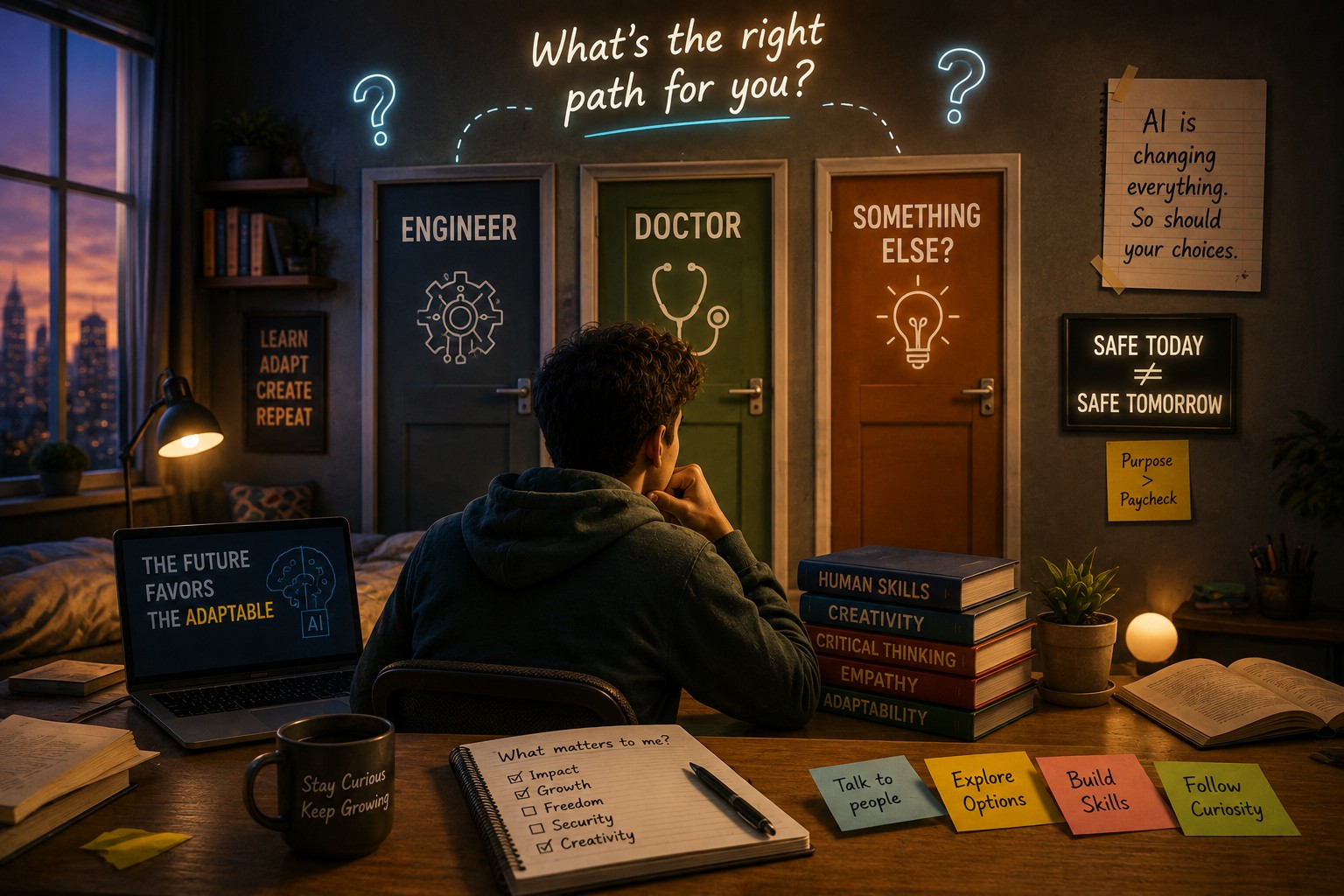
In many Indian households, the conversation about a child's future runs to a familiar shortlist. Engineering. Medicine. Perhaps chartered accountancy, or law. These are the careers a parent can name with confidence, the ones that promise a respectable and predictable life. Choosing one has long felt like the responsible thing to do.
That instinct came from somewhere real. For decades these paths offered a clear ladder: a known entrance exam, a known degree, a known first job, a known trajectory. In an uncertain world, certainty is worth a great deal.
But the ground under the word "safe" has shifted. It is worth understanding how, before the next child is pointed down a path out of habit.
What made these careers feel safe
Two things, mainly. Predictability and respectability.
Predictability, because the route was legible. You could see every step from the coaching class to the settled career, and each step had a clear entrance. Respectability, because the titles carried social proof that reassured the whole extended family.
Neither of those qualities was about the work itself. They were about the path being easy to understand and easy to be proud of. That is exactly the kind of safety that is now being quietly withdrawn.
What AI is actually changing inside them
Here is the uncomfortable part. AI is not threatening these fields from the outside. It is reshaping them from within, and it is starting at the bottom rung, precisely where new graduates enter.
In software, a large share of routine coding, the work that once filled a junior engineer's first years, is now assisted or automated.
In medicine, routine documentation, first-pass image reading and standard information lookup are increasingly handled by machines. The doctor's judgment matters more than ever, but the routine tasks that used to train juniors are thinning.
In accountancy and law, standard drafting, reconciliation, research and review, the classic apprenticeship work, is being compressed.
Notice the pattern. The prestige at the top of these fields is intact. The routine work at the bottom, the rungs a beginner used to climb, is exactly what is being automated.
The danger is not that these careers disappear. It is that the easy entry into them is disappearing, while families still treat them as easy.
The real risk is not the field. It is the reason for choosing it.
Two students enter the same medical or engineering college. One chose it because the work genuinely fits them, and they intend to build real judgment. The other chose it because it was the safe, respectable default, and quietly plans to coast on the credential.
The first will do well in almost any version of the future. The second is exposed, because a credential on its own, without fit and without judgment, is worth a little less every year.
The risk was never engineering or medicine. It was choosing a demanding path for the wrong reason, and assuming the label would do the work.
So what does "safe" mean now?
Safety has quietly changed its definition. It used to mean a predictable path. Today it means adaptability and fit.
Adaptability is judgment and skill that still transfer when the tools and tasks change, which are exactly the capabilities that hold their value as AI improves. Fit is a genuine match between the work and the person, because fit is what carries a student through the hard middle years when motivation runs low.
A path chosen for fit, in a field that rewards judgment, is safer today than a prestigious path chosen out of habit. That is a real reversal, and it deserves to be said plainly to families still working from the old map.
This is not an argument against these careers
It would be easy to read all of this as "do not become a doctor or an engineer." That is not the point at all.
Medicine, engineering, law and accountancy can be excellent choices. They sit close to real people and real problems, they reward judgment, and they give more leverage to someone who uses new tools well. A student who is genuinely suited to one of them, and who aims for the judgment-heavy work rather than the routine, is in a strong position.
The argument is narrower and more useful. Choose the path because it fits and because the student will build durable capability inside it, not because it is the name a family already trusts.
How to actually decide
If you want to test a "safe" choice rather than assume it, a few honest questions help.
Does the day-to-day work actually suit this student, or only the title?
Where is the field heading in ten years, and which parts of it are being automated?
Is the student aiming for the judgment-heavy top of the field, or coasting on the entry credential?
Does the choice line up with a real strength, or fight against one?
Does the cost of the path make sense against the likely outcome?
A path that answers these well is genuinely safe. A path that only sounds safe rarely survives the questions.
The parent's role has changed too
A generation ago, a parent could hand down a map that mostly still worked. Today the map is being redrawn while the child is walking it. The most useful thing a parent can offer is not a destination borrowed from the last decade, but help making a good decision with today's information.
That is a harder role, and a far more valuable one.
If you want to pressure-test a path before committing years and money to it, our Education Pathway Diagnostic is built for exactly this decision. It looks at fit, cost, competitiveness and readiness, so a "safe" choice becomes one you have actually examined. You can also speak with an advisor to talk it through for your child specifically.